
Water Got In: Your Hour-by-Hour Cleanup Timeline for the First 48 Hours
Reading Time: 8 minutes | By Cura Maids Team
You hear it before you see it: a drip in the ceiling, a damp spot spreading across the baseboard, or a puddle by the back door after a night of hard rain. For a lot of Cary and Triangle homeowners, the next few hours decide whether this is a messy afternoon or a month-long problem.
Hurricane season runs through November 30, but you do not need a hurricane to get water in the house. Tropical leftovers, fall thunderstorms, a failed washing machine hose, and a roof leak all lead to the same question: what do I do in the first 48 hours after water gets into my home?
The CDC gives a clear target: clean and dry, or remove, wet items within 24 to 48 hours to keep mold from growing. This guide turns that window into a simple timeline you can follow, tells you what to keep and what to toss, and is honest about when to stop and call a restoration professional. If you are reading this before any water arrives, our Hurricane Season Home Prep Checklist covers the before-the-storm side.
Quick Answer: What Do I Do in the First 48 Hours?
| When | Your Job |
|---|---|
| Hours 0-2 | Get safe, stop the source, take photos |
| Hours 2-12 | Remove standing water and wet items |
| Hours 12-24 | Start air movement and dehumidifying |
| Hours 24-48 | Clean hard surfaces, sort keep vs. toss |
| After 48 | Still wet or moldy? Time to call a pro |
Table of Contents
Why the First 48 Hours Matter
Mold needs moisture, and the Triangle's humid climate gives it plenty to work with. The CDC's guidance for wet items after a storm is to clean and dry them, or remove them, within 24 to 48 hours. That is not a deadline after which your house is ruined. It is the window where fast action works best.
Think of it as a race between your drying and the humidity. Every hour you cut from the wet time helps. If you have already read our Heat Dome mold prevention guide, you know how quickly Triangle humidity can turn a damp spot into a problem. Water from a leak or storm just speeds that up.
Who we are: Cura Maids is a cleaning company, not a water-damage restoration or mold-removal company. This guide covers what a homeowner can safely do, and it tells you plainly when to bring in a restoration pro.
Hours 0-2: Safety and the Source
Before you grab a mop, deal with the things that can actually hurt you.
- Electricity first. If water has reached outlets, cords, or appliances, do not stand in it to flip a breaker. Call your utility or an electrician.
- Stop the source. For a plumbing leak, shut off the water at the fixture or the main. For a roof or window leak, put a bucket down and a tarp up if it is safe to reach.
- Take photos and video of the water, the damage, and anything wet before you move it. You will want them for your insurance company.
- Suit up. The CDC suggests rubber boots and plastic gloves for cleanup. Add eye protection if you are scrubbing overhead.
Also ask where the water came from. Rain through a roof or a burst supply line is one situation. Floodwater, a sewer backup, or an overflowing toilet is another, because that water can carry germs. Contaminated water is a job for professionals, which we cover below.
Hours 2-12: Get the Water Out
Now you are moving water and wet stuff out of the house, fast.
Remove standing water
Towels, mops, and a wet-dry vacuum all work for small amounts. A few inches or more across a room is a restoration-company job, since they have pumps and moisture meters that your shop vac does not.
Pull wet items off wet floors
- Lift area rugs and take them outside or to the garage to dry
- Get furniture legs off wet carpet, or set foil or plastic squares under them
- Move books, papers, and electronics to a dry room
- Empty wet cardboard boxes and drawers, since cardboard holds moisture for a long time
- Pull cushions and bedding and wash the washable ones on hot
Call your insurance company during this stretch. Many policies want prompt notice, and they will tell you what they need documented before you throw things away.
Dry first, clean second.
Once the water is out and the structure is dry, we handle the cleaning. Questions? We're happy to talk it through.
Call or Text: (919) 480-1051
✓ Background-Checked Teams | ✓ Free Quotes | ✓ Serving Triangle Since 2015
Hours 12-24: Start Drying
This is where most people lose the race, because wet surfaces look dry long before they are. The CDC's flood safety page recommends fans, air conditioners, and dehumidifiers to dry affected areas.
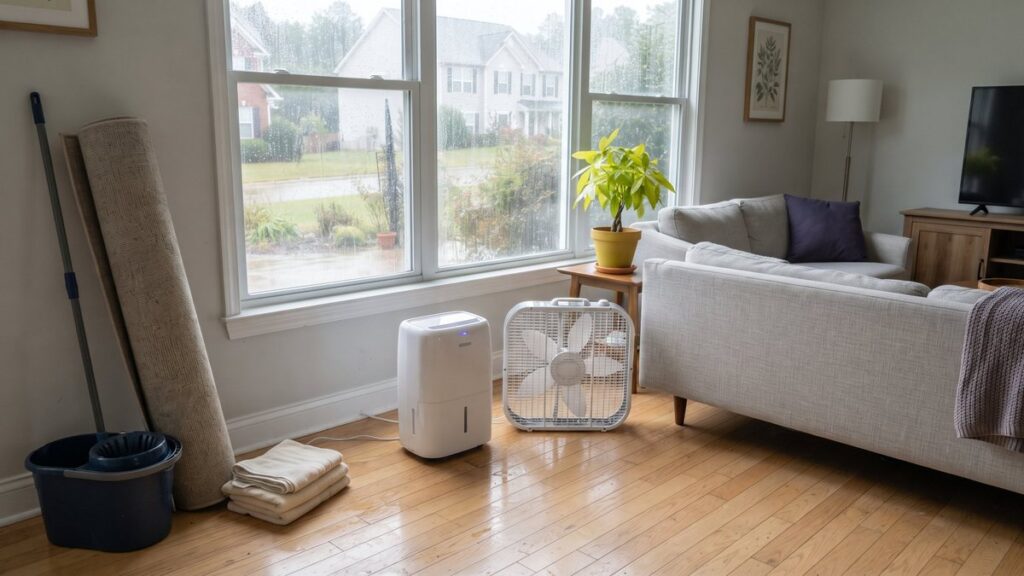
- Run a dehumidifier in the wettest room, with the door closed so it only works on that space
- Point box fans at wet walls and floors so air moves across the surface
- Use your AC on a normal setting. In the Triangle's humid air, it dehumidifies as it cools, and opening windows can bring more moisture in
- Open closet and cabinet doors and pull drawers out a little so air reaches the damp corners
- Check again at bedtime. Press a dry paper towel against the baseboard and wall. If it comes away damp, keep going
Hours 24-48: Clean and Sort
Surfaces that can be cleaned should be, while the drying continues. Per the CDC, wash walls, hard floors, and other surfaces with soap and water. To disinfect, the CDC's mix is 1 cup of bleach to 1 gallon of water.
Never mix bleach with ammonia or other cleaners. The fumes are dangerous. Use one product at a time, ventilate, and rinse between products.
Hard, nonporous surfaces such as tile, glass, metal, and sealed countertops are the easy part. The harder call is what to keep and what to toss:
| Item | General Guidance |
|---|---|
| Tile, glass, metal, plastic | Clean with soap and water, disinfect, dry fully |
| Drywall, wall coverings | Floodwater: the CDC says throw away. Clean-water leak: have a pro check it |
| Carpet and rugs | Floodwater: toss. Clean-water leak: a quick, thorough dry-out may save it, but ask a pro |
| Ceiling tiles, cardboard | Porous, so toss if wet or moldy |
| Washable fabrics | Wash on hot with detergent and dry completely |
The CDC's advice is to throw away items that cannot be disinfected, such as wall coverings, cloth, rugs, and drywall, when floodwater is involved. The EPA likewise says porous materials like ceiling tiles and carpet may have to be thrown away if they become moldy. When in doubt, photograph it first, then let it go.
Need Help Getting the House Back to Normal?
When the repairs are done and the house is dry, we handle the cleaning.
Book Now:
(919) 480-1051✓ Background-Checked Teams | ✓ Free Quotes
✓ 77-Star Cleaning Checklist | ✓ Serving Triangle Since 2015
When to Call a Professional
Doing it yourself has limits. Bring in a licensed restoration or mold professional if any of these apply:
✓ You can handle it
✓ Small clean-water leak
✓ A few damp towels' worth of water
✓ Mold patch under about 10 sq ft
✓ Fully dried within 48 hours
❌ Call a pro
❌ Sewage or floodwater
❌ Water inside walls or ceilings
❌ Mold over about 10 sq ft
❌ Still damp after 48 hours
The ten-square-foot line comes from the EPA's mold cleanup guidance, which also says to consider a professional for large areas, a lot of water damage, or sewage and other contaminated water. If anyone in your home has health concerns, check with a health professional before cleaning up mold yourself.
After Everything Is Dry: The Cleaning Comes Next
Once the structure is dry and the damaged materials are out, your home is still dusty, gritty, and overdue for a real clean. Drying equipment stirs up dust, and everything you moved around is now out of place.
This is where a fresh start helps. A deep cleaning Raleigh NC homeowners rely on resets baseboards, floors, bathrooms, and kitchens in one visit. If you are in Cary, our team offers house cleaning Cary NC families can book for a one-time reset or ongoing visits.
We do not do water extraction, structural drying, or mold removal. We clean, and we are good at it. That clear line keeps you from paying for the wrong service.
FAQs: Cleaning Up After a Storm or Leak
How long does it take for mold to grow after a leak or flooding?
It depends on the materials and the humidity, so there is no single number. The CDC's guidance is to clean and dry or remove wet items within 24 to 48 hours to prevent mold growth. Past that window, damp materials in a humid climate like the Triangle are at higher risk, which is why drying fast matters more than any exact timer.
What should I do first when water gets into my house?
Make it safe: stay out of water near electrical items, stop the source if you can, and take photos. Then remove standing water and wet items and start fans and a dehumidifier. Call your insurance company early, since they may have documentation requirements.
Is it safe to clean up storm water myself?
For a small leak of clean water, usually yes, with rubber boots and plastic gloves. Floodwater and sewage can carry germs, so those are professional jobs. Never mix bleach with ammonia or other cleaners.
What can be saved and what has to be thrown out?
Hard, nonporous surfaces can be cleaned and disinfected. Porous items soaked by floodwater, such as drywall, wall coverings, cloth, and rugs, are usually thrown away per CDC guidance. Ceiling tiles and carpet that turn moldy often cannot be fully cleaned either, per the EPA.
When should I call a professional instead of cleaning it myself?
Call one for sewage or floodwater, water inside walls, anything still damp after 48 hours, or mold covering more than about 10 square feet. The EPA uses the ten-square-foot mark as the line for homeowner cleanup.
Does Cura Maids clean homes in Cary and the Triangle after a storm or leak?
Yes, once the home is dry and any damaged materials are out. We clean; we do not do water extraction, structural drying, or mold removal. We serve Raleigh, Durham, Cary, Wake Forest, Apex, Holly Springs, Morrisville, Garner, and Fuquay-Varina.
The Bottom Line for Cary Homeowners
Water in the house is stressful, but the plan is simple: get safe, get the water out, dry everything, then clean. Aim for the 24 to 48 hour window, keep the equipment running, and bring in a professional the moment the job is bigger than a towel and a dehumidifier. Save this page, or text it to a neighbor who is dealing with a leak right now.
Ready for the Clean After the Mess?
When the water is gone and the repairs are done, a professional clean helps your home feel like yours again.
At Cura Maids, we bring background-checked, reliable teams to Triangle homes. Since 2015.
Serving Raleigh, Durham, Cary, Wake Forest, Apex, Holly Springs, Morrisville, Garner, and Fuquay-Varina.
Let's get your home sparkling again.
(919) 480-1051 Request Free Quote✓ Free Quotes | ✓ Reliable Teams
✓ 77-Star Cleaning Checklist | ✓ Background-Checked Teams | ✓ Serving Triangle Since 2015
#CaryNC #StormCleanup #TriangleNC #CuraMaids #RaleighNC #DurhamNC #WakeForestNC #ApexNC #HollySpringsNC